New Balance Cushioning Guide: Commute vs. Short-Distance
| Published | |
|---|---|
| Revised | |
| Editors | Maya Chen Editor-in-Chief |
# New Balance Cushioning Guide: Commute vs. Short-Distance If you're checking New Balance [sneakers](https://fashion-reps.net/shoes) on fashionreps, the easiest thing to misjudge isn't the color or brand name, but equating "thick sole" or "support structure" with "definitely soft." This post tackles one specific task: using visible specs on product pages to make an initial call on whether a pair of New Balance sneakers is more suited for daily commutes, short periods of standing, or short-distan
Editor score 4.2 / 5
If you're checking New Balance sneakers on fashionreps, the easiest thing to misjudge isn't the color or brand name, but equating "thick sole" or "support structure" with "definitely soft." This post tackles one specific task: using visible specs on product pages to make an initial call on whether a pair of New Balance sneakers is more suited for daily commutes, short periods of standing, or short-distance activities, and identifying what else you need to verify before ordering.
This article is not a substitute for actual try-ons or professional foot assessments, nor does it treat page claims as completed cushioning tests. Page prices, stock, sizes, and link statuses can change; the information below was verified on October 8, 2026. fashionreps pages are for discovering products and viewing organized product information; the page shows that after clicking the buy button, you'll be directed to an external shopping agent of your choice, and orders, payments, and shipping are handled by the agent's website.

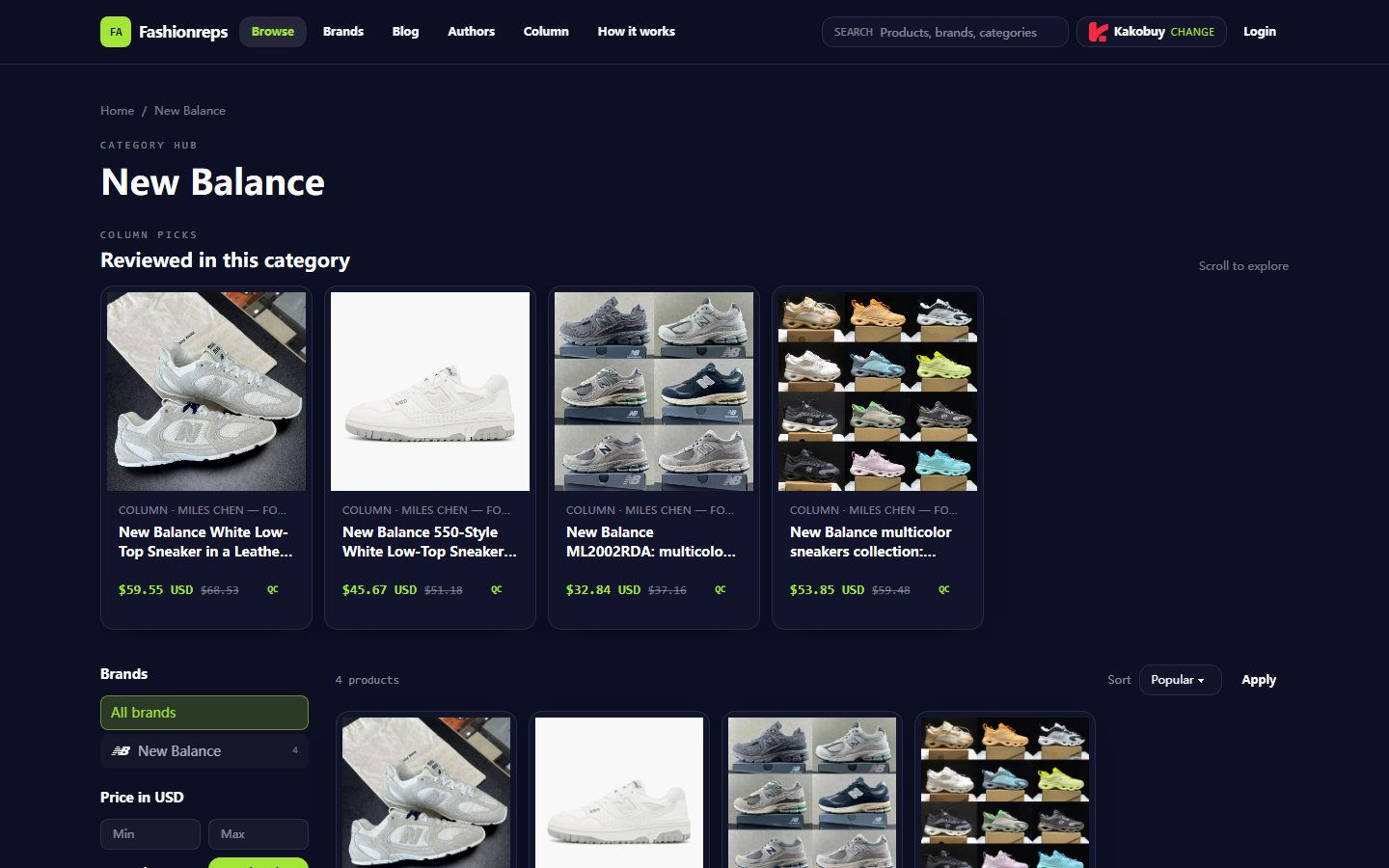
Image: Screenshot of fashionreps New Balance category page, verified on October 8, 2026.
Define the Use Case and Scope for New Balance Sneakers
Here, "cushioning" is not a single parameter you can confirm from a product title alone. For commuters, the more practical questions are usually: Does the sole have enough structural space? Do the upper and sole descriptions support daily wear? Does the shoe shape fit your foot? And does the page provide verifiable sizing and real-world evidence?
After reading this article, you should be able to do three things:
- Distinguish between "page facts" and "editorial inferences" from product titles and visible structural descriptions.
- Narrow down candidates based on your usage time, distance, and standing needs.
- List questions you must clarify with the agent or seller before purchasing regarding sizing, sole, materials, and real photos.
This framework is not for substituting medical advice, judging professional performance of running shoes, or guaranteeing that a shoe suits specific conditions like flat feet or plantar pain. Without lab cushioning data or complete wear tests on the page, long-term comfort cannot be confirmed.
Record Shoe Models, Sizes, and Visible Specs from fashionreps Product Pages
The New Balance category page verified shows 4 product entries, with visible product names, some material or structural descriptions, and reference prices. Reference prices are the prices displayed at the time and do not represent the final payment amount; they exclude agent service fees, domestic forwarding, international shipping, taxes, or other possible charges.
| Visible Product | Visible Structure/Material Info | Reference Price at Verification | Initial Use Assessment |
|---|---|---|---|
| New Balance White Low-Top Sneaker in a Leather and Sheepskin Trainer Build | Leather and sheepskin description, low-top trainer build | $59.55 | Better to first check upper thickness, lining feel, and commute suitability; don't infer softness from material names alone |
| New Balance 550-Style White Low-Top Sneakers in Eight Colorways | 550 style, low-top, 8 colorways | $45.67 | Can be a casual daily candidate, but need to confirm sole hardness, insole length, and toe room |
| New Balance ML2002RDA | Pigskin suede, mesh, and T-Beam support description | $32.84 | Richer structural description; suitable for further checks on support placement, sole photos, and sizing data |
| New Balance multicolor sneakers collection | Mesh and PU casual upper, 3–5 cm height increase description | $53.85 | Height increase changes footbed height and center of gravity; prioritize stability and heel lockdown before long commutes |
The above only records visible info from the category page. The page does not provide uniform test results for actual cushioning material, hardness, rebound, weight, or durability of each shoe, so none of them should be labeled "softest," "most comfortable," or "suitable for everyone."
Distinguish Between Page Claims, Structural Descriptions, and Editorial Inferences
When reading a product page, you can separate the information into three layers.
Layer 1: Facts explicitly stated on the page, such as mesh, PU, pigskin suede, T-Beam, or 3–5 cm height increase. These can serve as screening clues, but should still be confirmed on the product detail page and with real photos.
Layer 2: Reasonable structural inferences. For example, mesh usually suggests the upper may focus more on breathability; height increase usually means the footbed height and center of gravity will change; a support structure name hints at possible extra design in the midfoot. We use "may" and "needs verification" because product titles alone cannot prove wear outcomes.
Layer 3: Conclusions that cannot be drawn directly from the page, including softness/firmness, fatigue after hours of standing, heel slippage, sole durability, and suitability for specific foot issues. To confirm these, you need at least real photos, detailed measurements, credible try-on records, or standardized tests; the current category page provides none of these evidences.
Understanding Sole Thickness, Midsole Structure, and Underfoot Feel
A thick-looking sole does not mean good cushioning. Thickness may come from the outsole, foam midsole, height-increasing structure, or visual design. What really affects underfoot feel includes material density, structural continuity, insole thickness, heel stability, and upper lockdown.
When checking a product page, evaluate in this order:
- Find clear photos of the sole side, outsole bottom, and heel to confirm the thickness is real structure, not camera angle.
- Look for midsole material, insole, and support structure descriptions. Just having a name doesn't prove cushioning performance.
- Check for significant forefoot-to-heel offset, especially for height-increasing models that may shift your center of gravity.
- Consider your usage time. Short outings generally require less sustained cushioning than standing all day, but both need proper sizing and stable heel lockdown.
- Record both "what the page says" and "what it doesn't say" to avoid being swayed by a single adjective.
For this category page, the ML2002RDA title includes T-Beam support description, but that only states the page claims such structure exists; it doesn't prove support effectiveness. For models with 3–5 cm height increase, prioritize stability, heel lockdown, and forefoot space over cushioning. 👟
Trade-offs for Commutes, Prolonged Standing, and Short-Distance Activities
Commutes typically involve walking, subway transfers, stairs, and moving around the office. The key needs are accurate sizing, minimal heel slippage, enough forefoot room, and a sole that feels stable on various surfaces. When the page only lists materials or style, you cannot skip these verification items.
Prolonged standing amplifies issues with sole hardness, insole support, and upper pressure more than a regular commute. If a product page lacks real insole thickness, inner length, sole structure, or reliable wear records, treat it as a candidate to verify, not a confirmed standing shoe.
Short-distance activities involve less time and mileage, so appearance, style, and weight may matter more, but still check sole flex point and heel stability. Low-top casual models aren't necessarily suitable for continuous exercise; the category "sneakers" doesn't automatically replace the intended use of professional athletic shoes.
A simple screening approach:
- Mostly short commutes: Prioritize checking sizing, sole traction photos, and heel lockdown.
- Need long standing: Look for midsole, insole, sole hardness, or real-world evidence; be conservative if missing.
- Need short-distance activities: Confirm sole flex and toe room; don't rely only on looks and sole thickness.
- Specific foot shape/conditions: Consult a professional before deciding.
Steps for Shoe Shape, Foot Shape, and Sizing Verification
New Balance models with similar styles may differ in last, upper material, and lining padding, so don't order based only on your usual brand size. If the page lacks clear inner length and width info, ask the agent or seller for verifiable data.
Before purchasing, record:
- Actual length of both feet in millimeters, using the longer foot as the baseline.
- Forefoot width and whether you need a wider last.
- Sock thickness you typically wear.
- Whether you use standard insoles or additional support insoles.
- Target shoe's inner length, insole length, upper height, and heel opening dimensions.
- Whether the sole flexes easily and if the flex point matches your forefoot position.
If you only get verbal replies from the seller, keep uncertainty. Request photos of the insole or inner length with a ruler, and confirm consistent measurement methods. If size charts, product titles, and real photos disagree, pause and re-confirm instead of using "size up" as a universal solution. 📏
Handling Uncertainty When Page Lacks Tested Data
This category page provides product names and some structural descriptions for initial screening, but no uniform weight, sole hardness, rebound, wear tests, walking distance, or standing feedback. Thus, this article can only offer a verification path, not invent test conclusions that don't exist.
A sound recording method:
- Confirmed: Product names shown on page, visible material/structural descriptions, verification date, and reference prices at that time.
- To confirm: Actual stock, complete size chart, inner length, sole photos, insole thickness, weight, and pre-shipment QC images.
- Should not infer: Real cushioning level, long-term durability, suitability for all foot types, professional sports performance, and medical adaptability.
Prices should be understood as total cost. The category page's reference prices of $32.84 to $59.55 only cover the product prices shown; final costs may include agent service fees, warehousing, domestic shipping, international shipping, destination taxes, exchange rates, and return/exchange costs. Re-confirm on your chosen agent's website before ordering.
Pre-Purchase New Balance Sneaker Checklist
Before submitting an order, confirm each item:
- Does the product title match the target model? Is there a different version of the same model?
- Is the current product page still accessible? Are price, stock, and sizes updated?
- Are inner length, foot width, and insole dimensions documented?
- Are descriptions of upper, lining, midsole, and outsole clear and distinct?
- Are there clear photos of the sole, heel, insole, and upper?
- If choosing models with T-Beam or height increase, have you confirmed support placement, center of gravity, and heel lockdown?
- What are the agent website's service fees, warehousing, shipping, taxes, and return/exchange terms?
- Can you submit QC issues or request after-sales within the specified time after delivery?
- Have you kept a record of page info and price verification date to avoid treating changing info as fixed facts?
Final advice: Use fashionreps category pages as discovery and initial screening tools, and treat product details, size measurements, QC images, and agent policies as pre-order confirmation steps. If a page only offers appearance and basic descriptions, the safest conclusion is "worth further verification," not "proven excellent cushioning." ✅
For budget-conscious individuals needing only short-distance commutes, lower reference prices may reduce the product cost itself, but savings don't directly equal final savings, as shipping, service fees, and return costs can alter the total. Combining parcels may reduce repeated first-weight or handling costs but could increase package volume, declared value, or single-loss risk; splitting parcels may add fixed fees but suit route restrictions or lower per-shipment risk. Whether to combine depends on actual package weight, volume, destination taxes, and agent quotes.
Do not buy solely based on words like "support," "thick sole," or "sneakers" in the title when lacking size measurements, sole photos, or return conditions.