Balenciaga Hummer Boots: Resolve Size Conflicts
| Published | |
|---|---|
| Revised | |
| Editors | Maya Chen Editor-in-Chief |
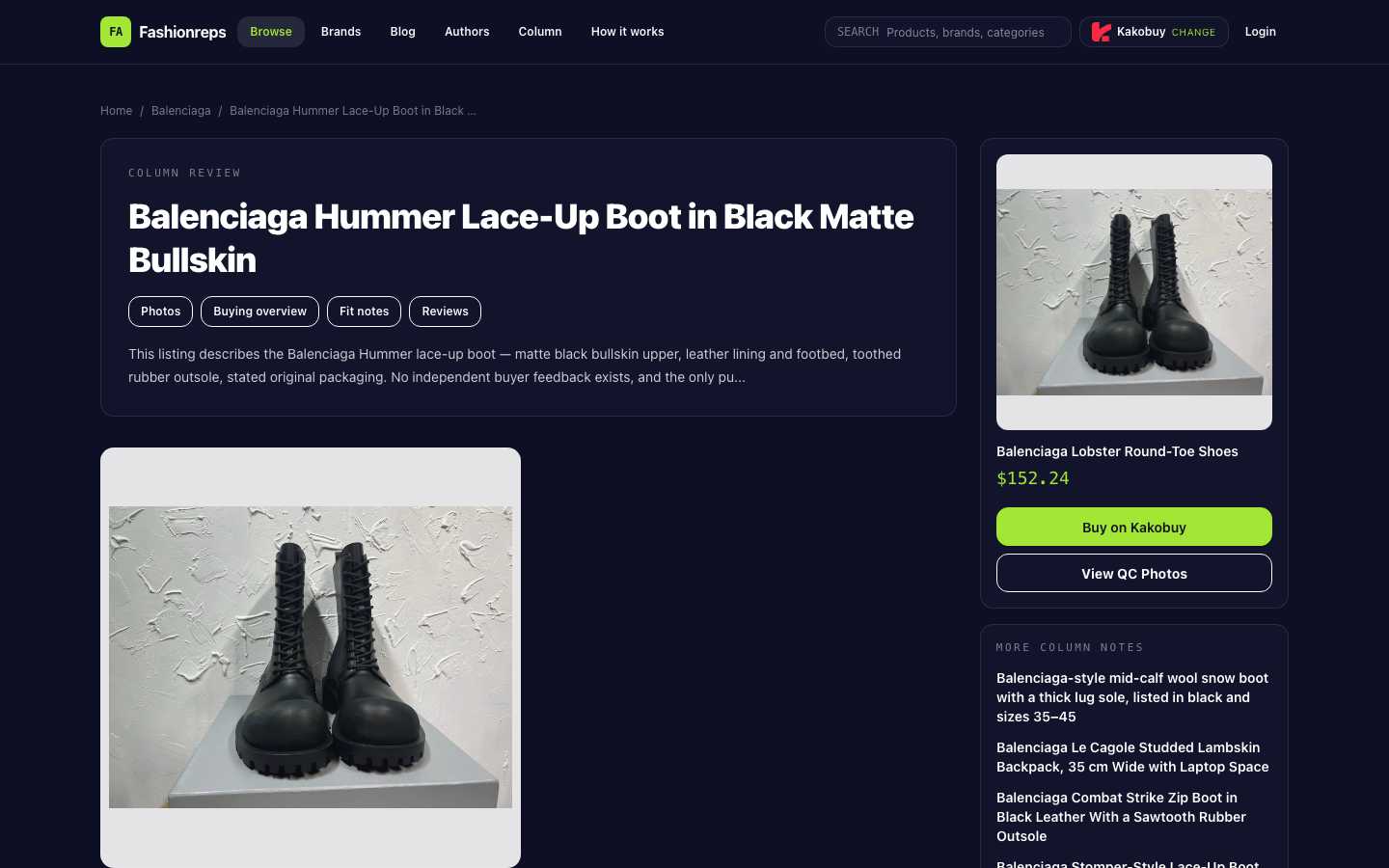
These Balenciaga Hummer black lace-up boots currently cannot be ordered based on just one size recommendation on the page. The product page simultaneously displays two different sets of size information: the description section lists 39–46, while the specifications column lists 35–40. Exter
Editor score 4.2 / 5

These Balenciaga Hummer black lace-up boots currently cannot be ordered based on just one size recommendation on the page. The product page simultaneously displays two different sets of size information: the description section lists 39–46, while the specifications column lists 35–40. External retail page recommendations are also inconsistent; one place suggests buying your usual size, while another believes the style runs large and recommends considering a size down. The page also lacks independent buyer feedback to verify these claims.
Therefore, the key to actual size selection is not to first determine whether it is "true to size" or "runs large," but to first confirm the specific sizes available for purchase from the agent, as well as the insole length for the corresponding size.
Break Down the Page Conflicts First
The two sets of numbers on the page belong to different fields and cannot be directly inferred as a complete inventory range. 39–46 may come from the product description, while 35–40 comes from the specifications, but the existing evidence is insufficient to determine which set is the latest or the actual range available for ordering. Unless confirmed by a shopping agent, 35–46 should not be considered a continuous range of available sizes.
External recommendations can also only be treated as information to be verified: the true-to-size advice and the runs-large advice contradict each other, and there are no independent buyer reports indicating insole length, fit, or changes after wear. Based on this information, it is not possible to responsibly give a fixed size conclusion that suits everyone.
Determine Size in This Order
- Measure foot length and width. Stand while wearing the socks you plan to pair with the boots and measure both feet separately, taking the longer measurement from the longest toe to the heel; also record foot width, especially if you have a wide forefoot.
- Confirm actual inventory with the shopping agent. Do not just ask, "Do you have size 40?" Instead, have the agent confirm whether the item is currently purchasable, what sizes are available, and which set of information in the product description or specifications column corresponds to current inventory.
- Request the insole length for the corresponding size. Prioritize asking for insole length measured separately for left and right feet, or request warehouse photos with a measuring tape. Insole length is more suitable for comparison with personal foot length than the size numbers on the page.
- Also ask about sole length and toe shape. Outer sole length cannot be directly equated to insole length, but it can help identify whether the measurement is unusual. The Hummer's toe allowance, lining thickness, and sock thickness will also affect actual space; if the agent cannot provide this information, the conclusion should be considered incomplete.
- Consider lace adjustment as a secondary factor. The lace-up structure can help adjust the fit over the instep and midfoot, but it cannot compensate for insufficient insole length. If the length already touches the toes, you should not choose a size down just because the laces are adjustable.
- Finally, compare "usual size" and "possibly one size down." If the insole length allows a margin that matches your wearing habits, then consider external true-to-size or runs-large opinions; if measured data conflicts with recommendations, prioritize verifiable measured data over vague size descriptions.
Checklist for Shopping Agent
Before placing an order, you can send the following questions at once:
- What sizes are currently actually available for purchase? Please check the differences between the page description and specification column separately.
- What is the insole length for the size I need? Can you provide warehouse measured photos?
- What is the outer sole length? What are the measurement start and end points?
- Can you confirm the measurement method for left and right feet, insoles, or linings?
- After arrival at the warehouse, can I request additional photos of the size label, insole length, and sole?
- If the measured size contradicts the page information, can the order be canceled, size exchanged, or returned? What are the associated costs and time limits?
When to Delay Purchase
If the agent cannot confirm actual inventory and can only repeat the two sets of sizes from the page, or cannot provide the insole length, sole length, and return/exchange conditions for the corresponding size, then these boots should not be treated as a clearly purchasable recommendation.
Similarly, if you must rely on independent buyer feedback to judge comfort, durability, or actual sizing deviation, current public information does not meet that requirement. A more prudent approach is to wait for the agent to confirm measured data, or choose a product with more complete size information and buyer feedback.
The current decision conclusion for these Hummer black boots is: first verify actual inventory, then match personal foot length with insole length, and finally use external size opinions as secondary reference. Existing page evidence is insufficient to support a single size answer, nor should either set of numbers, 39–46 or 35–40, be directly regarded as the final inventory range.