Acne Studios Knit Tops: Verify Neckline, Length, and Size
| Published | |
|---|---|
| Revised | |
| Editors | Maya Chen Editor-in-Chief |
The Task: Verifying Fit Evidence for acne studios Knit Tops Before Purchase When buying acne studios fall/winter knit tops, the most important things to confirm before ordering are not the brand name or a single model photo, but whether the neckline, body length, chest, sleeve length, and page size all point to the same specific item. This guide is for buyers who have already found a product page and are ready to place an order, but still cannot
Editor score 4.2 / 5
The Task: Verifying Fit Evidence for acne studios Knit Tops Before Purchase
When buying acne studios fall/winter knit tops, the most important things to confirm before ordering are not the brand name or a single model photo, but whether the neckline, body length, chest, sleeve length, and page size all point to the same specific item. This guide is for buyers who have already found a product page and are ready to place an order, but still cannot tell whether the fit will work.
After reading, you should be able to create a reviewable evidence record: confirm the product variant, save key measurements, cross-check the neckline, cuffs, and hem details, and pause the purchase if the information conflicts. If the product page lacks a clear size chart, specific variant photos, or explainable measurement instructions, this guide cannot replace further verification.

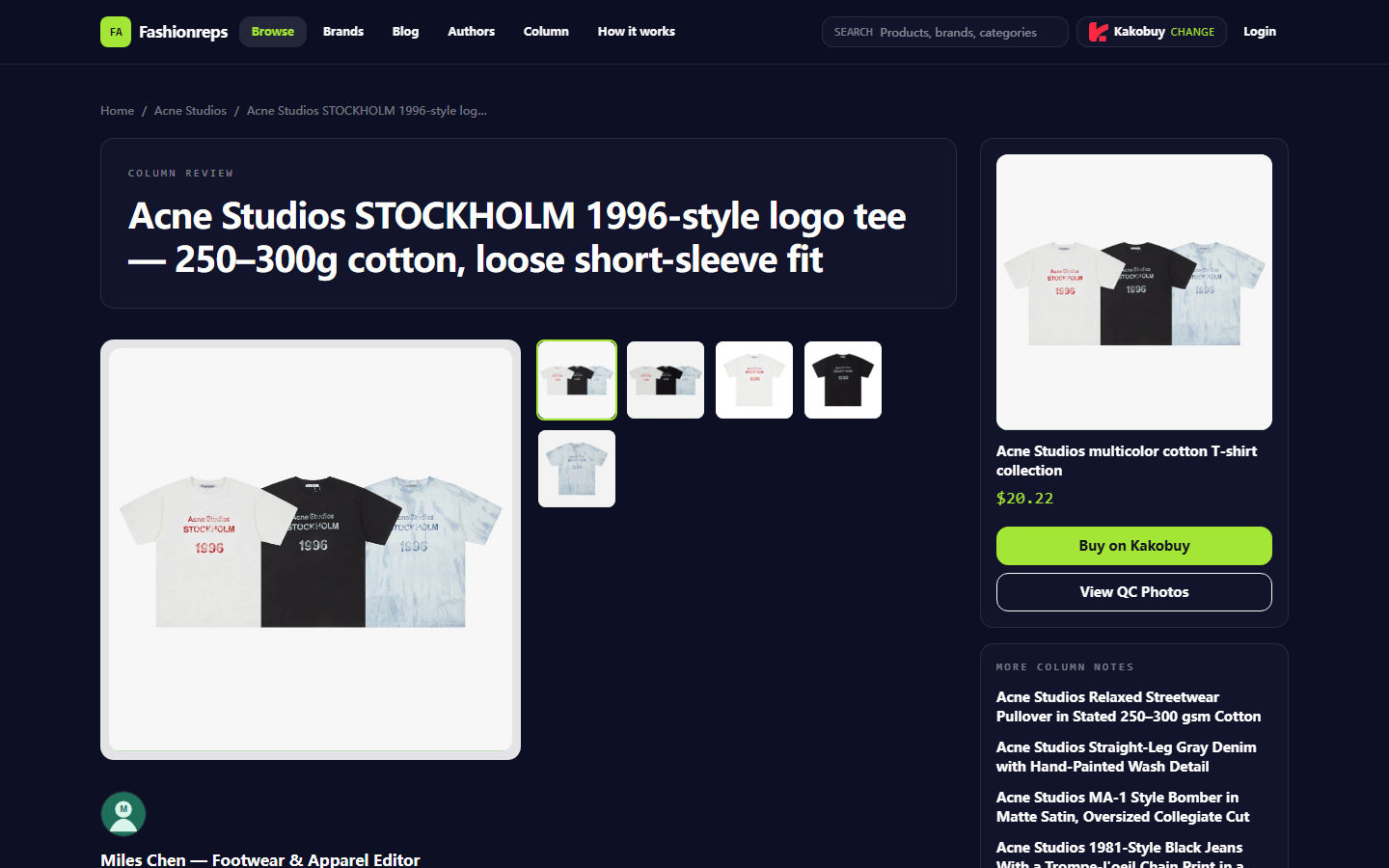
The image shown above is from a reference product page on fashion-reps. It displays a STOCKHOLM 1996 style short-sleeve T-shirt, not the fall/winter knit top we are verifying here, so it can only serve as an example of page evidence recording, not as proof of the knit top's neckline, length, warmth, or fabric feel.
First, Record the Product Page's Style, Color, Size, Neckline, and Length Fields
Record the current contents of the product page completely, not just the product title. In particular, confirm which color and size you are viewing, because switching variants may change images, stock, or measurement fields.
Recommended items to record:
- Product page title and last update time
- Style name or item number, if provided
- Currently selected color, size, and stock status
- Neckline description, e.g., crew neck, half-zip, collar, or other
- How body length is measured: from shoulder point, center back neck, or elsewhere
- Chest, shoulder width, sleeve length, and hem width
- Whether the page states a measurement tolerance, and the range
- Whether the size chart applies to garment measurements or recommended body measurements
- Whether the current price, service fee, and international shipping are listed separately
Price, stock, size, and link status are time-sensitive. This article does not treat the reference page's price as the current price for the knit top; before ordering, rely on the product page and the shopping agent's checkout page as displayed on the verification date. 🧾
If the page only says "relaxed fit", "thick", "premium feel", or "fall/winter style" without corresponding numeric measurements, those words are not enough to judge length and proportion. Save a screenshot or text record, then ask the seller or shopping agent for the missing fields.
Cross-Check Neckline, Cuffs, Hem, and Overall Silhouette with Product Images
The goal of image checking is not to determine whether it "looks authentic", but to confirm whether the page text matches the displayed style. At minimum, review front, back, neckline close-up, cuff close-up, and hem close-up images; a single distant photo has low evidentiary value.
For the neckline, check in this order:
- Whether the neck height and opening width match the text description
- Whether the neckline lies flat, is slightly loose, or stands up noticeably
- Whether the ribbing or binding is continuous and symmetrical
- Compare front and side photos to avoid mistaking inner layers or layered looks for collar structure
For body length, consider the overall silhouette:
- Whether front and back lengths are the same, or if the page clearly states a longer back hem
- Where the hem falls: at the waist, above the hips, or covering the hips
- Compare sleeve length to body length ratio; don't infer size from model height alone
- If product images show visible clamping, folding, or stretching, do not treat visual length as actual measured length
Cuffs and hem are also worth recording. Rib width, degree of cinching, slits, rolled edges, or irregular edges change the silhouette, but lighting, posing, and post-processing in images cannot prove elasticity, softness, or post-wash condition. 🔍
Verify That the Size Chart, Measurement Instructions, and Page Variant Correspond
The most reliable method is to use a knit top that already fits you well as a reference. Lay the reference flat, measure its body length, chest width, shoulder width, and sleeve length, then compare with the product page's data using the same measurement points. Do not simply subtract your body chest from the garment chest, because knit fabric stretch, pattern, and wearing ease affect the result.
Focus on three correspondences:
- The size chart belongs to the current product, not a generic store chart.
- The size chart corresponds to the current color and style, not another variant.
- Measurement start and end points are clear, especially for body length and sleeve length.
If the page uses chest circumference but your reference garment only provides chest width, first confirm whether it is a flat single-side measurement or a full circumference. A common conversion is flat chest width times two, but you must confirm the page does not use a special measurement method, and you cannot treat this conversion as official page data.
When facing size tolerances, record measurements as a range instead of pretending to have an absolute precise number. For example, if the product body length is listed as a certain value and the page also states possible manual measurement error, your record should retain that error and judge whether it still falls within an acceptable range.
If two fields conflict, such as the text saying "cropped" but images clearly show hip coverage, or the size chart's body length changes unreasonably with size, pause the purchase. First confirm whether the conflict comes from page updates, variant switching, different measurement standards, or incomplete product information. 📏
Distinguish Between Page-Visible Facts, Community Feedback, and Editorial Judgment
Your verification record should layer evidence, avoiding turning others' experiences into current product facts.
Page-visible facts include the colors, sizes, images, text descriptions, and measurement fields currently shown on the product page. They can support statements like "the page lists a certain neckline", but cannot automatically prove the actual item matches the description exactly.
Community feedback should only be treated as leads to verify. Even if someone discusses the same brand, series, or similar style, it cannot directly prove the current product's length, shrinkage, warmth, or comfort. If the seller, batch, or product link in the review differs, further reduce the evidence strength.
Editorial judgments should be clearly labeled as judgments. For example, based on images, the silhouette may appear relaxed, but that does not equal a completed try-on or confirmed comfort. This article does not claim to have personally purchased, received, worn, or tested the product; the content was compiled by the Panda-Buy Editorial Desk from page fields, images, and verification methods, and the scope of automated production and fact-checking should be disclosed truthfully in the site's explanation page.
What Information Cannot Prove Fabric Feel, Warmth, and Wearing Comfort
Product images can help identify neckline, cuffs, and hem, but they cannot alone prove the following:
- Whether the fabric is soft, itchy, or prone to pilling
- Whether the knit density is sufficient for specific temperatures
- Whether it shrinks, deforms, or fades after washing
- Whether the neckline will stretch out
- Whether cuffs and hem have stable elasticity
- Whether it feels stuffy or uncomfortable after hours of wear
"Thick", "premium", "warm", and "skin-friendly" are descriptions that require specific evidence. If the page lacks composition percentages, weight, knit structure, care instructions, or credible same-item feedback, record these items as unknown rather than adding inferences. For fall/winter knit tops, composition percentages and care labels are especially important because they affect care method, shrinkage risk, and actual cost of use. 🧵
Steps to Pause and Seek Clarification When Information Is Missing or Fields Conflict
When key evidence is insufficient, handle it in this order:
- Save the current product page's title, variants, and size chart to prevent inability to review after later page updates.
- Mark specific gaps, such as missing back length, neckline close-up, or size data for the current color.
- Ask the seller or shopping agent a single, answerable question; avoid just asking "how is the quality?"
- Request confirmation of measurement start and end points, applicable variant, and possible tolerance.
- After receiving a reply, check whether it corresponds to the current product and current size.
- If the reply still uses vague words like "normal", "suitable", or "thick", do not treat it as numeric evidence.
- If page text, images, and replies contradict each other, keep records and pause the purchase.
When it comes to customs, taxes, or import restrictions, declare truthfully according to the destination country's rules. Do not reduce costs through undervaluing, splitting orders to avoid taxes, or evading inspection. Size verification and consolidated shipping decisions should also be handled separately; do not ignore size evidence for a single item just because you plan to consolidate shipping. ⚠️
Pre-Purchase Action Checklist After Completing Your Evidence Record
Before placing the order, confirm that the following items have reviewable evidence:
- The current product is indeed the target knit style, not a similarly named T-shirt or other category
- Color, size, and page images belong to the same variant
- Neckline, collar structure, cuffs, and hem basically match the text description
- Body length measurement method is clear and uses the same standard as your reference garment
- Chest, shoulder width, and sleeve length are sufficient to support your fit judgment
- No unexplained field conflicts on the page
- Fabric composition, care instructions, and warmth remain unknown have been separately marked
- Price, stock, service fee, and international shipping have been reconfirmed on the verification date
- If warehouse inspection is needed, you have listed in advance the items to check: neckline, hem, stitching, labels, and size measurements
- In case of size mismatch, you understand the shopping agent's and seller's after-sales window and required evidence
If you choose to buy first and rely on warehouse inspection later, it may increase turnaround time, service fees, and return/exchange risk; it suits buyers who cannot get enough evidence from the product page but are willing to bear verification costs. If you must confirm length and neckline before ordering, and the seller cannot provide clear data, then the "buy first and guess later" approach is not recommended.
After completing this record, what you save is not a guaranteed fixed amount, but reduced returns, reshipments, and extra warehousing costs caused by size errors. The cost is the time to measure a reference garment, save page evidence, and possibly pay for warehouse inspection or later processing. It suits buyers who value fit, plan to consolidate shipping, and are willing to keep evidence; it does not suit those who only look at the brand name, assume their usual size always works, or cannot accept information uncertainty.