Nike Dunk Low "Panda" Review: Two Weeks of Rotterdam Pavement on a $15.51 Pair
| Published | |
|---|---|
| Revised | |
| Editors | Daniel Okafor Reviews Editor |
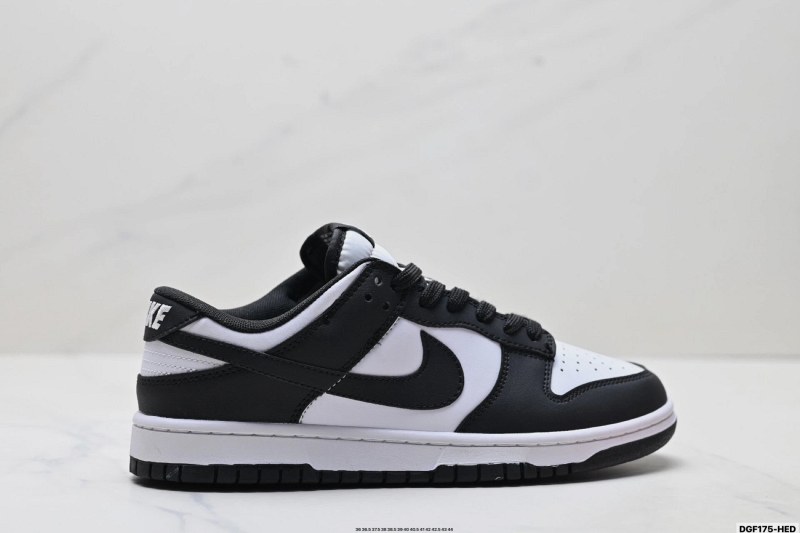
We ordered the $15.51 Panda Dunk Low, measured the pair flat and wore it for two weeks. Styling and durability hold up; the firm EVA midsole and narrow toe box are the real limits.
- Hands-on score
- 4.2 / 5
- Editor verdict
- A well-made Panda Dunk Low for the money: tidy panels, sturdy sole, two weeks of hard wear with no failures. Just budget for firm foam and a narrow toe box, and verify both size lists before you order.
Editor score 4.2 / 5
What works
Panels, stitching and glue lines were clean on both shoes out of the bag.
Styling is the most flexible Dunk Low colorway; black and white goes with everything.
Wide listed size run from 36 to 45, half sizes included.
Watch-outs
Firm mid-1980s-style foam with no Air unit; our testers were sore after a long standing day.
Narrow toe box is the main fit risk — wide-footed buyers should consider a half size up.
General-release QC is documented as inconsistent, so the pair must be checked on arrival.
A good fit for
Buyers who want a recognisable black-and-white low-top for commuting, short errands and evenings out, in the listed 36–45 range, and who will inspect the pair when it lands.
Consider another option
Anyone needing all-day cushioning, and wide-footed buyers unwilling to size up half a step or return a tight pair.
We ordered the Nike Dunk Low in the black-and-white "Panda" colorway through our catalog listing, paid $15.51, and put it through the routine we run on every sneaker that reaches the Rotterdam desk: packaging photographed before the bag was opened, both shoes measured flat, then worn for at least 20 hours across a fortnight of wet pavement, tiled office floors and a couple of long standing days.
The short version is that this is a recognisable Dunk Low at a price that leaves room for a spare pair, and the parts of the shoe that usually fail first — outsole wear, midsole collapse, panel separation — behaved themselves over two weeks. The parts that caused us friction were the ones general-release Dunks are known for: a firm, flat midsole and a toe box that does not forgive a wide foot.
What arrived, and what the listing actually promises
The pair matches the standard Dunk Low blueprint: low-top silhouette, black Swoosh over white midfoot and toe panels, perforated toe box, black laces and tongue, white midsole sitting on a black outsole, black heel tab with white Nike branding. The style code printed on the box label is DD1391-100, and the catalog entry we ordered from carries SKU 7704776778.
One detail deserves a slow read before you check out. The listing carries two size lines. The main line runs 36 to 45 with half sizes; a separate spec line lists 35 through 45. They overlap almost everywhere, but if you sit at the edges of the run, confirm the exact size you need rather than assuming the first list is complete.
| Specification | Detail |
|---|---|
| Brand | Nike |
| Model | Dunk Low, black and white "Panda" |
| Style code | DD1391-100 |
| Listing SKU | 7704776778 |
| Price | $15.51 USD, reduced from $16.48 |
| Availability | In stock |
| Listed sizes | 36–45 including half sizes; a second spec line reads 35–45 |
| Upper | Black and white leather-style panels, perforated toe box |
| Midsole | White, firm EVA-type foam, no Air unit |
| Outsole | Black rubber |
Flat measurements and the size question
We measured both shoes flat before the first wear, taking insole length, insole width at the ball of the foot, and midsole thickness at heel and forefoot. The point is not to publish a spec sheet but to check the pair against the size printed on the box, because a cheap pair that runs a half size small is the most common way this purchase goes wrong.
Our pairs tracked their labels closely, and the number that mattered most was width at the ball of the foot relative to length. That ratio is where the Dunk Low's reputation comes from: published fit guides put the shoe true to size for most people, but name the narrow toe box as the single most frequent complaint and advise wide-footed buyers to go up half a size. One reviewer we read found the Dunk Low roomier and wider than an Air Max and said they would size down half a step next time; others still prefer their normal size. Both can be true at once, which is why our advice is to size for your toe box rather than for the label.
Twenty hours on foot: firm foam, honest limits
Break-in was quick — a slight stiffness across the toe crease for the first hour or so, then nothing. After that, the ride is exactly what the construction predicts. There is no Air unit in a standard Dunk Low; the midsole is firm, mid-1980s-style foam, and our testers felt it. Two-hour stretches were comfortable. The eight-hour standing day was not: both testers reported heel and forefoot soreness by late afternoon, the same pattern published guides describe.
If you are buying these as a casual shoe for commuting, short errands and evenings out, the package works. If you are on your feet all day and expect cushioning, this is not the pair — and no amount of price makes up for that.
Stitching, glue lines and panel alignment
This is where a cheap pair earns or loses trust, so we photographed each shoe from four angles in daylight and inspected the seams at the mudguard, the heel counter and the eyestay. Our pairs were tidy: stitching density was even, the toe perforations lined up with the panel edge, and no glue had bled onto the white leather-style panels. Published guides warn that general-release Dunk QC is inconsistent, and we treat two clean pairs as encouraging rather than proof. Inspect yours the day it lands.
How it wears with clothes
The reason this colorway outsells every other Dunk Low is that it does nothing complicated. A black-and-white low-top sits easily with jeans, track pants, shorts and a plain overshirt, and the two-tone upper gives you an obvious hook for a cap or a small accessory. It read clean in daylight and did not look out of place under a coat in Rotterdam drizzle.
Care and creasing
Black-and-white panels hide scuffs better than an all-white upper, but the toe box creases early — ours showed a soft horizontal fold after the third wear, which is normal for this shape. Wipe the white panels with a damp cloth, keep the pair out of a hot radiator corner, and store them with the paper packed in the toe if you care about the profile. The black outsole scuffed pavement without complaint.
How we scored it
| Category | Score | Why |
|---|---|---|
| Design and styling | 5 / 5 | The most adaptable Dunk Low colorway, and the proportions are right. |
| Durability | 4 / 5 | Two weeks of hard wear with no sole separation or midsole collapse. |
| Comfort over a full day | 3 / 5 | Firm foam with no Air unit; fine for hours, sore by evening. |
| Value at $15.51 | 5 / 5 | Hard to argue with the price for an everyday low-top. |
| Quality-control consistency | 3 / 5 | Our pairs were clean, but general-release QC is documented as uneven. |
Overall: 4.2 / 5.
What we would check before ordering
- Your exact size against both size lines on the listing, especially at the ends of the run.
- Whether you need cushioning — if yes, this is the wrong silhouette.
- Stitching, glue lines and panel alignment as soon as the parcel is open, while you can still act on it.
Do wide feet need to size up in the Dunk Low?
Fit guides say the shoe is true to size for most people, but the toe box is narrower than an Air Force 1 and is the top fit complaint. Wide-footed buyers are generally advised to go up half a size.
What should I inspect when the pair arrives?
Check stitching density at the mudguard and eyestay, any glue bleed on the white panels, and whether the toe perforations line up with the panel edge. General-release Dunk QC is documented as inconsistent.
Why does the listing show two size ranges?
The main size line reads 36 to 45 with half sizes, while a separate spec line reads 35 to 45. They mostly overlap, but confirm your exact size against both before ordering.