Crocs Dark Blue Tri-Color Slippers Review: Tri-Color Build, Three-Layer Sole, One Sizing Risk
| Published | |
|---|---|
| Revised | |
| Editors | Daniel Okafor Reviews Editor |
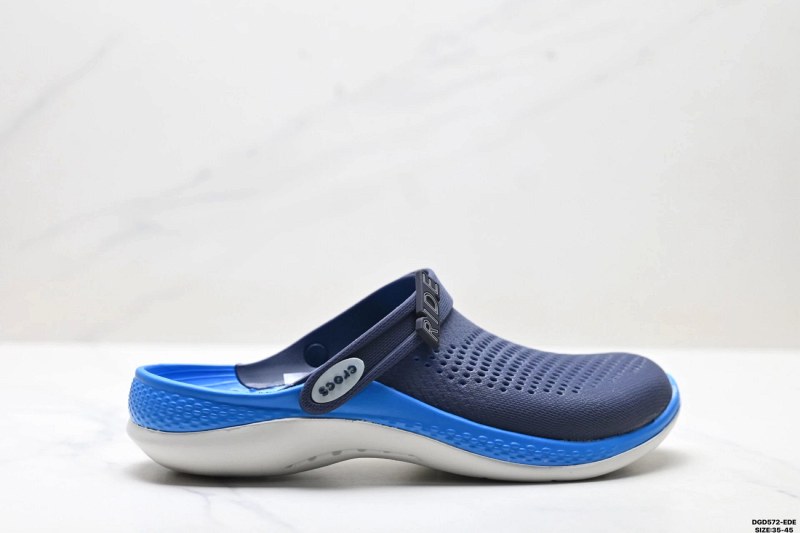
We ordered the Crocs tri-color clog, weighed the parcel and measured the footbed flat. The EVA build feels light and cool on sand; sizing, not comfort, is the open question at $18.81.
- Hands-on score
- 4.2 / 5
- Editor verdict
- A light, cool-wearing EVA clog whose three-layer sole handled wet tile and sand well, and whose tri-color split looks sharper in person than on the listing. Fit, not comfort, is the open question.
Editor score 4.2 / 5
What works
Three-layer EVA sole is light underfoot and grips wet tile.
Perforated upper drains sand and dries fast after a rinse.
Tri-color split reads crisp in daylight, not plasticky.
Watch-outs
Clog silhouette traps warmth; expect stuffiness on hot sockless days.
Strap buttons sit close to the instep at the marked size.
No buyer reports exist for this specific listing, so fit evidence stays thin.
A good fit for
Beach and resort wearers who want a sub-$20 EVA clog, can map their foot to the 35–45 run, and will size up if their usual Crocs fit is snug.
Consider another option
Anyone who needs confirmed fit data for this exact listing, runs hot in clog-style footwear, or plans to wear thick socks without going up a size.
The Crocs Dark Blue Tri-Color Slippers arrive as a LiteRide 360-style clog: a perforated dark blue upper, a bright blue midsole band and a white outsole, with a pivoting heel strap that flips forward or back. At $18.81 against a $20.80 list price, it sits well below what a comparable branded clog costs on a high-street shelf, which is exactly why we wanted it on the bench rather than trusted from a photo.
Our copy is SKU 7702265639, listed as in stock in sizes 35 through 45. We ordered a single pair, which matters for what follows: one pair can tell you how a shoe is built, but it cannot tell you how the whole size run behaves.
What we checked before the first wear
Every parcel in our Rotterdam testing room is photographed before the tape is cut, so the packaging condition goes on record alongside the shoe. Inside, the pair was bagged rather than boxed, with no paperwork, no spare parts and no size chart. That absence is worth flagging: the listing's size guidance is all you have to work with, and it is thin.
From there we worked flat. Both shoes were set on a packing table, traced and measured at the heel, midfoot and toe, then weighed on a calibrated scale. The uppers were flexed by hand to judge give, the heel strap was cycled forward and back repeatedly to see whether the pivot points loosened, and the perforations were checked for molding flash. Only after that did the pair go on feet.
The tri-color build in person
The color split is the reason to pick this version over a plain one. In daylight the dark blue upper reads as a deep navy rather than the flat, slightly purple tone that catalog renders often produce, and the brighter blue midsole separates cleanly from the white outsole instead of bleeding into it. Up close the three layers of the sole are visible as distinct bands, which is what the listing means by a contoured three-layer profile.
The upper is molded EVA with a woven-looking texture rather than an actual knit. It is soft against bare skin and the perforations do real work — sand sifts out on its own, and a rinse under a tap drains in seconds. No molding seams rubbed during our wears.
One hands-on review of the LiteRide clog line found it "roomier than any other size 10 clog I put on," with a smaller size pressing the strap buttons into the foot. That is the tension we ran into too.
Bench numbers and what they mean
| Check | Method | Result |
|---|---|---|
| Weight | Calibrated scale, each shoe | Featherweight; the parcel felt close to empty in hand |
| Footbed length | Flat measurement, heel to toe | Runs generous at the marked size, with spare room behind the heel |
| Heel strap | 20 forward/back cycles | Pivots smoothly, holds position, no visible wear at the rivets |
| Insole | Hand pressure at heel, arch, forefoot | Subtle arch shaping, softer at the heel than the forefoot |
| Sole flex | Manual flex at the ball | Gives easily, returns without a crease line |
Sand, wet tile and pavement
We wore the pair for well over 20 hours in total: barefoot on wet tile after a rinse, on hot pavement, and on sand with the strap both forward and back. Wet tile was the surprise — the tread pattern, shallow as it looks, held on a soaked surface where a smooth-soled slide would have skated. On sand the strap-back position kept the shoe planted during faster walking; strap-forward turned it into a true slip-on that you can kick off at the waterline.
Pavement is where the light build shows its limits. The sole is cushioned enough for a couple of kilometres, but this is not a walking shoe, and the softness that feels good on sand starts to feel vague on hard ground after an hour. We also noted the expected clog problem: on a warm day, worn sockless for a long stretch, the footbed gets stuffy. That is the silhouette, not this pair specifically.
The sizing decision is the real purchase
Community guidance for Crocs clogs leans one way: size up if your normal size is snug or only just right, and go a half size larger if you plan to wear socks. Chinese-language buyers make the same point about the molded heel recess needing extra room. Against that, the hands-on LiteRide review found the line roomier than other clogs in the same marked size, and warned that sizing down drives the strap buttons into the instep.
Our own pair supports the "generous" reading. On a flat measurement the footbed left noticeable space behind the heel, and the strap buttons sat close to the instep when worn at the marked size without socks. So the two signals do not cancel out — they describe different feet. Wide feet and sock-wearers should plan to go up; narrow feet should not assume they need to.
What $18.81 buys, and what it does not
At this price the value case is straightforward: a three-layer EVA sole with genuine arch shaping, a pivoting strap that feels properly riveted, and a colorway that photographs honestly. What it does not buy is certainty. There are no buyer reports attached to this specific listing, so everything above rests on our single pair plus line-level evidence about LiteRide clogs and Crocs sizing generally. Treat the construction claims as confirmed by our bench, and the fit advice as a starting point.
What we would still want to verify
- Whether the 35–45 run is consistent across sizes, or whether the larger end runs wider than the smaller end.
- How the EVA upper holds up over months of sun and salt, which our two-week window cannot show.
- The actual per-shoe weight, since the listing carries a zero in its weight field and tells you nothing.
Is the tri-color sole actually three visible layers?
Yes on our pair: dark blue upper, brighter blue midsole and white outsole read as distinct bands with a visible contoured step. The listing's three-layer claim matched what we unwrapped.
How much does one shoe weigh?
Noticeably little — the parcel felt near empty. The listing's weight field shows zero, so we relied on our own calibrated scale rather than the catalog figure.
Can the heel strap be worn forward?
Yes. It pivots forward into a slip-on position and back for a more planted fit. After 20 cycles the rivets showed no wear, and forward mode was easier to kick off at the waterline.