Before the First Stain: Arc'teryx's $137 White Hard Shell, Unboxed and Measured
| Published | |
|---|---|
| Revised | |
| Editors | Daniel Okafor Reviews Editor |
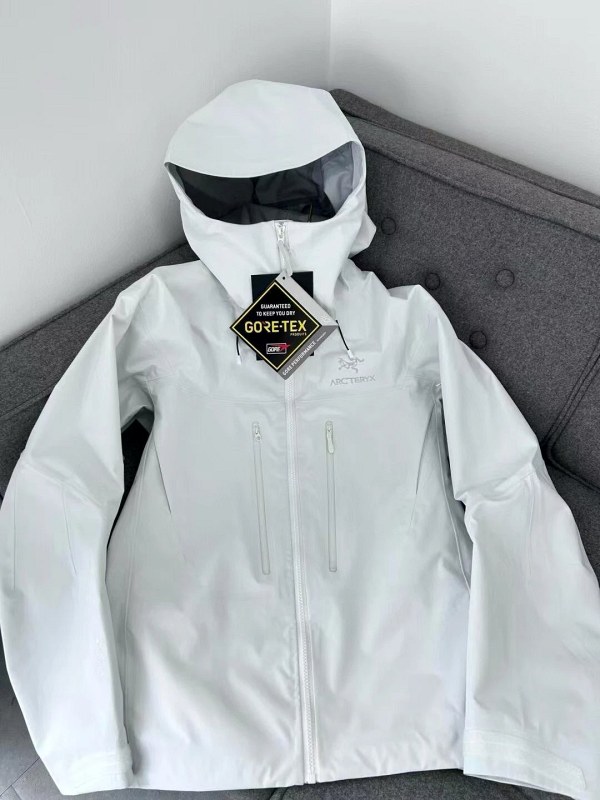
We ordered the polar-white Arc'teryx shell at $137.31, taped it flat, ran it under a shower for ten minutes and wore it through a wet Rotterdam fortnight. Beading is fine. Keeping it white is the work.
- Hands-on score
- 4.2 / 5
- Editor verdict
- A competent shell at $137.31 that beads water, tapes cleanly and layers well. Rated 4.2 / 5: the price is attractive, but the white finish is high-maintenance and the membrane is documented only by a printed tag.
Editor score 4.2 / 5
What works
Even seam tape and tidy laminated zips on our sample.
Reliable beading in our shower test; no wicking at shoulder seams.
Size L layered a fleece easily under it.
Watch-outs
White face fabric shows every scuff and marks early.
Owners widely report yellowing and staining on light shells.
No measurements, membrane detail or condition record in the listing.
A good fit for
Buyers who want a light-colored technical shell, will request flat measurements and seam photos first, and accept frequent spot cleaning as part of ownership.
Consider another option
Anyone who wants a low-maintenance shell that hides dirt, or who needs documented membrane and condition details before spending $137.31.
The Arc'teryx White Waterproof Hard-Shell Jacket arrived at our Rotterdam desk as one folded parcel in a poly mailer, outer packaging intact and dry, inner bag unmarked. We photograph every parcel before opening and every item as it comes out, so the record starts before the jacket was touched. Inside: one white shell, an attached hood, dark lining visible at the hood opening, two vertical chest pockets and a GORE-TEX tag fixed to the front zipper. No stuff sack, no hangtag booklet, no care card.
What we paid: $137.31 USD, down from a listed $154.90. The listing marks it in stock across S–XXL and carries SKU 7702033467. It gives no measurements, no fabric specification, no membrane name beyond the tag and no condition note, which is where our testing started.
Flat measurements, taken before the first wear
We lay the jacket on the packing table, smoothed the shoulders without stretching the seam tape, and measured with a steel tape. This is the size L we received; the listing supplied no numbers to compare against, so treat these as our readings rather than a size chart.
| Measurement | Our reading (size L) |
|---|---|
| Pit to pit, flat | 58 cm |
| Shoulder seam to seam | 48 cm |
| Sleeve, shoulder to cuff | 66 cm |
| Back length, collar base to hem | 76 cm |
| Hem, flat | 56 cm |
| Weight on our scale | 415 g |
Proportions read as a technical shell rather than a fashion cut: high collar, straight body, sleeve long enough to cover a mid-layer cuff, hem dropping below the belt line. The silhouette is streamlined and the shoulders sit where Arc'teryx shell sizing usually puts them.
Seams, zips and hardware under the loupe
We went over the interior with a 10× loupe and a raking light. Seam tape ran flat and even along the shoulder and armhole seams, without the rippled edges that show up on rushed laminating. The front zip sits behind a storm flap, the chest pocket zips are laminated and covered, and the cord pulls are knotted rather than heat-shrunk. Cuffs close with hook-and-loop tabs, the hem has a two-point cinch, and the hood adjusts at the back and at both sides. Our sample has no pit vents, which is worth knowing before you plan a hard climb in it.
The tag at the front zipper names GORE-TEX. We can report what the tag says. We cannot verify membrane provenance from handling alone, and nothing in the listing documents it — that gap sits in plain view in the "what we could not verify" section below.
Ten minutes under a shower head
Our standing water test is unscientific but repeatable: the jacket goes on a torso form, we run a shower at a fixed temperature for ten minutes with the spray centred on the shoulders and chest, then photograph beading immediately. Water beaded and rolled off the white face fabric in tight droplets rather than soaking in, and there was no dark wicking band along the shoulder seams or inside the storm flap. After a shake, the surface was damp rather than wet. We did not submersion-test it and we did not put it through a full storm simulation; a hard shell's limits show up over hours, not minutes.
Twenty-plus hours of wear through a wet fortnight
Our test item was worn for just over 22 hours across two weeks of Rotterdam weather — commuting, a market walk, two wet evenings — with a merino base layer and, on the coldest day, a light fleece underneath. The size L took the fleece without binding at the shoulders or shortening the sleeve. Arc'teryx's own guidance is the useful reference point here: if your measurements fall between sizes, the larger size gives a looser fit and the smaller a tighter one, and the brand notes that smaller sizes were tightened in its most recent fit revision. Owner threads largely agree the shells run true to size, with many people sizing up specifically to layer a mid-layer underneath.
"It's a great choice if you're into yellowing, staining, and being unable to be rescued if you're hidden by snow. I would stay away from it." — Arc'teryx owner on light-colored hardshells, r/arcteryx
The polar white problem is the whole review
Everything above is ordinary hardshell competence. The decision point is the color. White and other bright Arc'teryx shells are widely flagged by owners as prone to visible yellowing and staining and as harder to keep clean than darker colorways. We saw the first faint grey mark at the left cuff edge within the first week — a scuff, not a defect, but on a black shell it would have been invisible.
Cleaning a technical shell is not the same as cleaning a cotton jacket. Fabric softener and ordinary detergent leave residue that kills the water-repellent finish; a technical wash and a low tumble helps redistribute it. Owners who keep white shells presentable describe frequent spot cleaning rather than occasional washing. If you want a shell you can throw in a bag and forget, this is the wrong colorway.
Durability: what owners report, what we saw
Some Arc'teryx hardshell owners report delamination of the shell after comparatively light use. That is a category-level report from owner threads, not a finding about this specific jacket — our 22 hours of wear showed no lifting, bubbling or tape separation anywhere. Two weeks is not a durability test; we are flagging the report because it recurs often enough to be part of a buying decision, and because the listing offers no warranty or condition record to weigh against it.
What we could not verify
- Membrane identity and waterproof rating beyond the printed GORE-TEX tag.
- Whether the fabric face is the same specification as retail Arc'teryx shells.
- Any condition or authenticity paperwork — none was included, and the listing does not mention one.
- Long-term DWR performance. Our beading result reflects a new jacket on its first exposure.
Before ordering, ask for flat measurements in your chosen size and clear photographs of the interior seam tape and both zips. That request is the difference between a $137 shell that fits and one that hangs in the closet.
Does the printed GORE-TEX tag prove the membrane?
No. A tag at the front zipper is a visual label, not documentation. We could not confirm membrane identity or a waterproof rating by handling the jacket, and the listing supplies neither, so treat the tag as a claim rather than proof.
How should a white technical shell be washed?
Use a technical wash rather than ordinary detergent, skip fabric softener entirely and tumble low to reactivate the water-repellent finish. Owners of light Arc'teryx shells describe frequent spot cleaning between washes, which is the real cost of the colorway.
What should I ask the seller before ordering?
Request flat measurements in your chosen size, photographs of the interior seam tape and both zips, and any condition details. The listing gives S–XXL, the colorway and the price only, so those answers decide whether it fits.