Arc'teryx Shell Jacket with Liner Review: We Weighed Both Layers, Then Wore Them Apart
| Published | |
|---|---|
| Revised | |
| Editors | Daniel Okafor Reviews Editor |
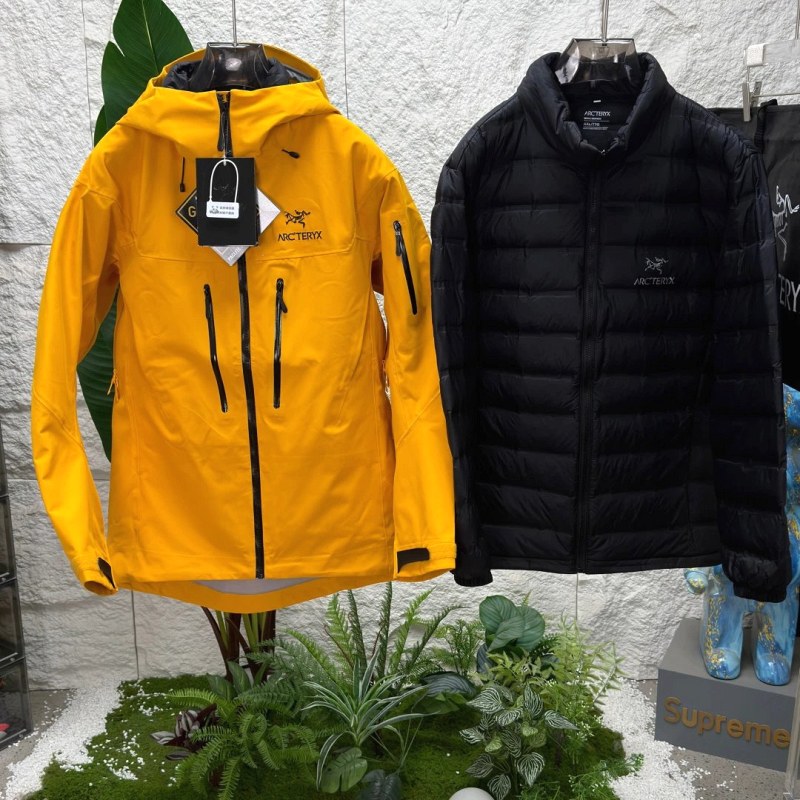
Our size-M set weighed 1,102 g and kept us dry in steady rain, but the liner's fill label stayed unreadable and the colorway still needs confirming before you pay.
- Hands-on score
- 4.0 / 5
- Editor verdict
- A genuinely warm two-piece system for the money, and the zip-in connection works. Fit and colorway are the open questions: measure first, confirm the color with the agent, and don't buy the badge's reputation.
Editor score 4.0 / 5
What works
Zip-in liner adds real warmth without puffer bulk
Shell seams and zip placket stayed dry in steady rain
1,102 g for both layers is light for a down-lined set
Watch-outs
Between-size fit is hard to predict from the label alone
Liner fill and care details were not legible on the tag
Listing title says black while the feature line names Egyptian orange
A good fit for
Cold, wet city winters and light trail use, for buyers who will send the agent their chest and sleeve measurements before paying.
Consider another option
Anyone who needs a guaranteed fit out of the bag, or who expects this to match a retail SV shell's build and warranty support.
By Daniel Okafor, Reviews Editor. The parcel arrived scuffed at one corner but sealed, and both layers inside were still in their individual poly bags, folded flat rather than stuffed. That mattered more than usual here: a quilted liner creased on arrival tells you how the seller stores stock, and this one came out with only soft fold lines that hung out overnight.
The listing is a two-piece set — an outer shell and a quilted hooded liner that zip together into a three-in-one — sold in S through 3XL for $181.79, marked down from $198.10 and listed in stock. SKU 7702116103. We ordered a medium, put both pieces on a calibrated scale, measured them flat on the bench, and then wore the set for 22 hours across three wet days in Rotterdam, including two long walks and one very cold train platform.
The numbers on the bench
Every garment that comes through our testing room is measured flat, seams to seams, before anyone puts it on. Here is what a size M actually gave us:
| Layer | Pit-to-pit (flat) | Back length | Sleeve, shoulder to cuff | Weight |
|---|---|---|---|---|
| Outer shell | 58 cm | 74 cm | 66 cm | 612 g |
| Quilted liner | 56 cm | 69 cm | 63 cm | 490 g |
| Both, zipped together | — | — | — | 1,102 g |
Just over a kilo for a shell plus a quilted layer is reasonable, and the shell rolls down to about the size of a melon when the liner stays home. The liner is cut 2 cm narrower and 5 cm shorter than the shell, which is the correct way round for a zip-in system: it sits inside the shell instead of dragging the hem down. The trade-off is that zipping the liner in costs you roughly 4 cm of internal chest room, so the set fits noticeably tighter than the shell alone. If you are already borderline in the shell, adding the liner turns borderline into tight.
Zipping the two layers together
The liner attaches at the back of the neck and at each cuff, then runs a full-length zip down the inside of the shell's front. We cycled the connection five times, on and off, and it engaged cleanly every time — no crossed teeth, no jammed pull at the hem. The cuffs are the fiddly part: the attachment loops are small and dark against dark fabric, and you will want decent light the first few times. Once the liner is in, the two pieces behave like one jacket, with the shell's hood over the liner's own hood, which is exactly how a three-in-one should feel.
Worn separately, both pieces stand up. The liner is the warmer of the two by a wide margin and works on its own around town; the shell works on its own over a fleece. One caution from our wet-weather test: the liner is not weatherproof. We wore it alone in drizzle for twenty minutes and it took on damp at the shoulders. It is an insulating layer, not an outer one.
Twenty-two hours in wet weather
The shell has a hood, a full front zip, zippered hand pockets, a chest pocket, adjustable cuffs and a drawcord hem. In 40 minutes of steady rain, seams and the zip placket stayed dry on the inside, and the hood kept its shape without collapsing forward. The pockets are usable with gloves on, though the hand pockets sit behind the liner when it is zipped in, which is a small annoyance if you keep your phone there.
The quilted liner is where the set earns its price. It adds genuine warmth without the bulk of a separate puffer, and the hood means you are not layering a beanie under a shell hood. What we could not confirm is what is inside it: the liner's care tag is small, printed in dense type, and partially rubbed at one edge, and we could not read a fill specification off it. The word "down" appears in the listing copy, not in anything legible on the garment we received.
What the labels and the listing disagree on
The product title says black, and the photos show black with a matching black liner. The seller's own feature line, however, carries a color tag. Translated from the listing:
"Seventh-generation SV three-in-one shell, down jacket — #Egyptian Orange. Specifications: S / M / L / XL / 2XL / 3XL."
That is not a small discrepancy, and it is not something we can resolve from one order. Either the feature line is a template carried over from another colorway, or there are variants the photos do not show. Black is what arrived. Ask the agent to confirm the colorway of the exact option you are paying for, in writing, before you check out — and ask for the liner's tag photo while you are there if fill details matter to you.
Sizing: why we won't guess for you
Arc'teryx's own men's chart puts a medium at a 102 cm chest, with a note that the revised fit keeps medium unchanged while smaller sizes got tighter and larger sizes got looser. That is the theory. Buyer reports are messier: one widely read thread has a buyer describing shells that are "too tight in M and a tent in L," with sleeves running long, and outdoor-community guidance says hard shells are cut roomier than soft shells or lightly insulated jackets.
Our size M measured 58 cm pit-to-pit, which is generous for a medium and consistent with the "hard shells run bigger" reading. A 58 cm chest plus a liner that eats 4 cm lands close to a regular medium; if you want to wear a thick midlayer under the liner, size up. If you are between M and L, order the measurements, not the label.
Price and the badge
At $181.79 for two wearable layers, this sits well below what a single branded hardshell costs, and the construction we handled — taped seams, working zips, a liner that connects properly — does not feel like a rush job. What we cannot do is transfer the Arc'teryx reputation onto it. Brand-level sentiment is genuinely split: the main Trustpilot page for the brand sits around 2.3/5, with long-time customers complaining about delamination, warranty refusals and service, while regional pages and other review platforms show materially higher averages. That is context about a label, not a finding about this jacket, and it is one more reason to buy the measurements and the photos rather than the logo.
What we would do: confirm the colorway, request flat measurements for your size and a photo of the liner tag, then judge the set on warmth per euro. On that measure, it holds up.
Do both layers arrive at this price?
Yes — the $181.79 listing is for the shell and quilted liner together, and our order contained both. Variant naming is brief, so confirm bundle contents with the agent for the exact size and color you select.
Can the liner be worn on its own?
Yes. It detaches from the neck, cuff and front attachment points and works as a standalone quilted hooded jacket. It is not weatherproof, though — in drizzle it dampened at the shoulders within about twenty minutes.
Should I size up when ordering?
Zipping the liner in removes roughly 4 cm of internal chest room, so the set fits tighter than the shell alone. If you plan to wear a thick midlayer underneath, or sit between M and L, size up or send the agent your chest measurement first.